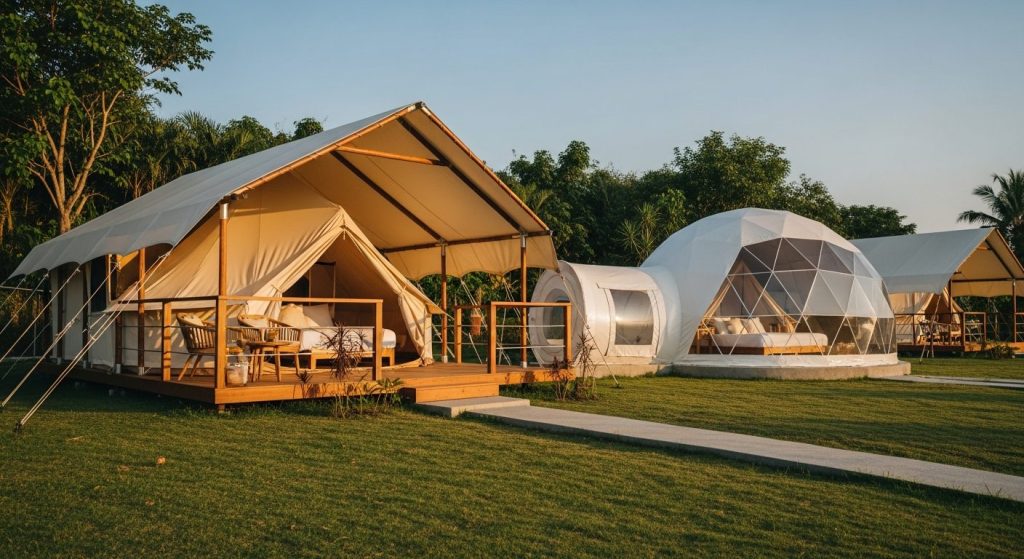
The best glamping in Bali is the site whose setting, tent or dome type, and service level match how you actually want to spend the night — a clifftop safari tent for a couple chasing sunrise privacy is a different “best” from a family-ready bell-tent cluster near Ubud’s rice terraces. Because no single property wins for every traveller, this roundup ranks Bali’s standout luxury-glamping options by clear criteria — who it suits, the region, the structure, what’s realistically included, and the price tier — rather than by ownership claims or invented awards. Bali Camping Luxury is an independent curator and editorial concierge, not a camp operator: we research and compare, then route your enquiry to vetted glamping sites. If you proceed with a partner, they may pay us a referral fee at no extra cost to you.
What follows is information to help you choose, not booking, financial, or licensed advice. We don’t own tents or land, we don’t run on-site service, and we don’t publish ratings we can’t attribute. Prices here are ranges, last verified June 2026, and always subject to change by the operator. Use this as a map, then confirm the specifics directly with whichever site you contact.
How we judge “best” glamping in Bali
“Glamping” — a blend of glamorous and camping — means staying in nature inside a structure that keeps real-bed comfort: safari tents, bell tents, geodesic eco-domes, and transparent stargazing bubbles, usually with a proper mattress, an ensuite or near-by bathroom, and electricity. It sits between a campsite and a boutique hotel. That middle ground is exactly why “best” depends on your trip.
We weigh five things, and we say so on every pick:
- Who it suits — couples, families with young children, honeymooners, remote workers, or retreat groups. These segments want genuinely different nights.
- Setting and region — Ubud jungle and rice terraces, the south coast around Canggu and the Bukit clifftops, lakeside highlands near Bedugul, or quieter beachfront in the north and east.
- Structure type — a safari tent feels like a canvas suite; a bell tent is cosier and often more affordable; an eco-dome and a bubble trade some privacy for sky views.
- What’s realistically included — bathroom style (private vs shared), air-conditioning or fans, breakfast, Wi-Fi, pool access, and how exposed you are to weather and insects.
- Experience tier and price — from accessible bell-tent comfort to design-led high-end domes, expressed as nightly ranges, not promises.
Why does the structure type matter so much? Independent US market data is a useful proxy here: cabins are the most-chosen glamping accommodation at roughly 72% preference, carrying an average daily rate near USD 292, while average glamping spend runs about USD 150–350 per night versus USD 20–50 for traditional camping. The lesson that travels to Bali: the more “suite-like” the structure, the higher the comfort and the rate. Match the structure to your tolerance for the outdoors.
Best glamping in Bali by traveller type
Rather than crown one winner, here is how the categories sort by who is travelling. Each row reflects the structure and setting that tend to fit best, with indicative nightly ranges (operator-published, last verified June 2026, subject to change).
| You are… | Setting that tends to fit | Structure type | Why it suits | Indicative price tier (per night) |
|---|---|---|---|---|
| A couple / honeymooners | Bukit clifftop or Ubud jungle | Safari tent or stargazing bubble | Privacy, views, and an ensuite; sunrise or sky-watching as the centrepiece | Mid to high (often USD 150–350+) |
| A family with young children | Ubud outskirts or lakeside highlands | Bell-tent cluster or family safari tent | Space, near-by facilities, and gentler nature exposure for kids | Low to mid (often USD 90–220) |
| A remote worker / digital nomad | Canggu or Ubud (near towns) | Safari tent with desk and power | Connectivity, services within reach, longer-stay practicality | Mid (often USD 110–260) |
| A design / luxury enthusiast | Clifftop or lakeside | Geodesic eco-dome or bubble | Distinctive architecture, materials, and a higher service level | High (often USD 250–500+) |
| A retreat or small group | Ubud highlands or rural north/east | Multiple bell or safari tents + communal space | Capacity, shared dining, and quiet hours for yoga or offsites | Varies by group size and buyout |
These ranges are starting points to calibrate expectations, not quotes. A clifftop dome over a peak holiday week can sit well above the top of its band; a shoulder-season bell tent can fall below it. Confirm the live rate with the site before you plan around a number.
Best glamping in Ubud (jungle and rice terraces)
Ubud is Bali’s centre of gravity for jungle glamping. The draw is canopy and valley views, river sounds at night, and easy access to wellness, food, and culture in town. Safari tents here can feel like canvas suites with private decks; bell tents tend to be the value choice for families. The trade-off is humidity and more insect life than the coast, so look for sites that describe screened windows, fans or air-conditioning, and a proper bathroom rather than a shared block.
Best clifftop and beachfront glamping (the south and the coasts)
For couples who want the ocean as the view, the Bukit Peninsula’s clifftops and quieter beachfront pockets in the north and east deliver the most cinematic settings. Clifftop safari tents and bubbles favour privacy and sunrise; beachfront sites favour swimming and sunset. Coastal wind can make canvas noisier, and exposure means weather matters more — so check what the operator says about shade, drainage, and what happens to your booking in heavy rain. We never guarantee weather or conditions; that’s the operator’s domain.
Best jungle and lakeside eco-domes for design lovers
Geodesic eco-domes and transparent bubbles are where Bali’s glamping looks most like the photos that go viral. They suit design enthusiasts and HNWIs who, as luxury-buyer research consistently shows, prize uniqueness and distinctive experiences over a familiar hotel chain. The honest caveat: a transparent structure trades some privacy and can run warm without strong cooling, so the best of these pair the sky-view drama with serious climate control and a genuinely private plot.
Glamping vs a boutique hotel: how to read the value
A common question at the awareness stage is whether luxury glamping is “worth it” against a boutique hotel or villa. The honest answer is that you’re buying a different product: proximity to nature and a distinctive structure, often at a comparable nightly rate to a mid-to-upper hotel. The category is established and growing, which matters for confidence that this isn’t a novelty.
- Global glamping market size (2025)
- Estimated at roughly USD 3.7–3.8 billion by multiple independent research firms (e.g., Grand View Research USD 3.79B; Fortune Business Insights USD 3.71B).
- Projected global market
- Forecasts range to about USD 7.9–11.1 billion by 2030–2034, implying a ~9–11% compound annual growth rate.
- Luxury-glamping segment specifically
- Valued at about USD 3.2 billion in 2025 and projected to reach USD 8.1 billion by 2034 (~12.4% CAGR) in one industry report — faster than broader luxury hospitality (~8.3% annually).
- Typical glamping spend per night
- Around USD 150–350 in US market data, versus USD 20–50 for traditional camping — a useful proxy for how the comfort premium prices out.
- Who glamps most
- Demand is led by experience-seeking segments: couples (currently the largest share), families with young children, remote workers, and retreat groups; Millennials and Gen Z are the leading age cohorts in US data.
Read those figures as context, not as Bali-specific guarantees. They tell you the category is mature and the spend is real; they don’t set the price of any particular tent on the island.
Once you’ve narrowed to a region and a structure type, the next step is matching your dates, group size, and must-haves to a specific site. That’s the part we help with directly. Tell us what your ideal night looks like and we’ll point you to vetted options — plan your Bali glamping escape and we can talk it through on WhatsApp.
How our curation works (and how we’re paid)
Being clear about roles is the whole point of an independent curator. We publish editorial comparisons and route enquiries; we are not the owner, manager, or booking guarantor of any site listed. Bookings, contracts, on-site service, safety, and compliance sit with the glamping operators themselves.
On money: if you proceed with a partner, they may pay us a referral fee at no extra cost to you. That referral model keeps the guide free and lets us focus on matching you to the right tent rather than selling you one. We don’t make best-price or lowest-rate claims, we don’t invent awards or “voted best” labels, and we don’t claim to have personally inspected every property unless we can show it. Where we mention third-party brands or certifications, we treat them as independent operators and name the issuing body and year — or we leave the claim out.
Practical things to confirm before you choose
Glamping is comfort in nature, which means a few details decide whether the night is magical or miserable. Before committing, ask the operator to confirm, in writing:
- Bathroom — private ensuite, semi-private, or shared block, and whether there’s hot water.
- Climate — air-conditioning, fans, and how the structure handles heat, humidity, and rain.
- Connectivity and power — Wi-Fi reliability and outlets, which matter most for remote workers.
- Access and transfers — road condition, distance from the airport or town, and parking.
- Policies — check-in, cancellation, child suitability, and what happens in severe weather.
For anything touching regulations, building safety, or health, treat our content as general information and confirm with the operator and the relevant local authorities. We describe operator-stated amenities; we don’t certify them.
Frequently asked questions
What counts as the “best” glamping in Bali?
There isn’t one universal best; the strongest choice is the site whose region, structure type, and inclusions match your travel style and budget. A clifftop safari tent suits a couple seeking privacy and views, while a bell-tent cluster near Ubud suits a family wanting space and near-by facilities. We rank by who each option suits rather than crowning a single winner.
How much does luxury glamping in Bali cost per night?
Indicative ranges run from roughly USD 90 for accessible bell tents to USD 500 or more for design-led clifftop domes, varying by season, region, and group size. These are operator-published ranges last verified June 2026 and are subject to change — always confirm the live rate directly with the site before planning around it.
Is glamping in Bali suitable for families with young children?
It can be, especially bell-tent clusters and family safari tents on Ubud’s outskirts or in the lakeside highlands, where there’s more space and gentler nature exposure. Confirm child suitability, bedding, bathroom setup, and cancellation terms with the operator, since on-site policies and safety are their responsibility, not ours.
Do you take a commission or charge me extra?
You pay nothing extra to us. If you proceed with a partner, they may pay us a referral fee at no additional cost to you, which keeps this guide free. We don’t make best-price or lowest-rate claims, and any booking, contract, and payment is handled directly by the glamping operator.
Are you a glamping operator or do you own the tents?
No. Bali Camping Luxury is an independent curator and editorial concierge. We research, compare, and route enquiries to vetted glamping sites and camp operators; we don’t own tents or land, and we don’t run on-site service. Everything we publish is information rather than booking, financial, or licensed advice.
When you’re ready to turn a shortlist into a plan, we’ll match your dates and preferences to vetted sites and make the introduction. Plan your Bali glamping escape — message us on WhatsApp with your dates, group size, and the kind of night you’re picturing, and we’ll take it from there.