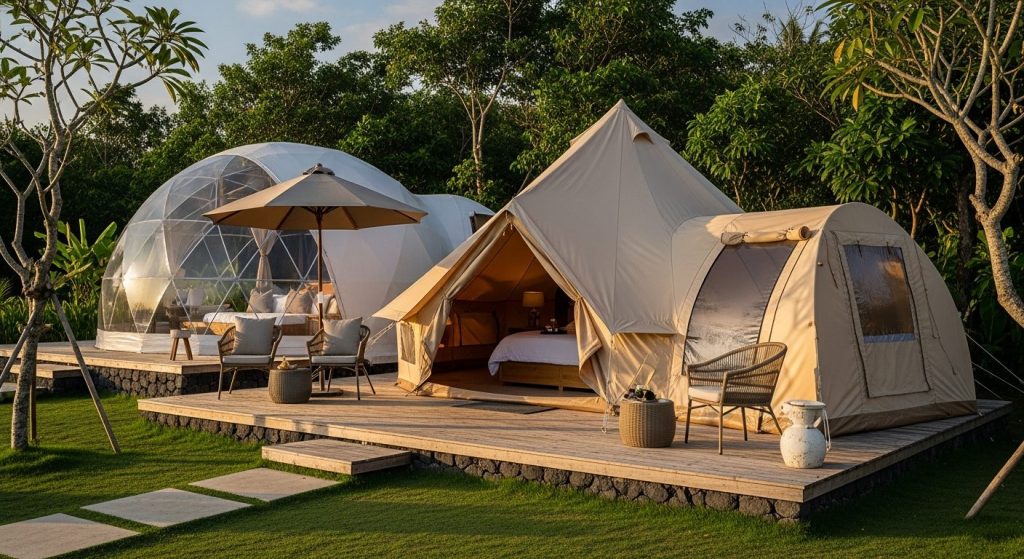
Safari tents in Bali are large, canvas-walled glamping structures built on raised platforms, fitted with proper beds, en-suite or private bathrooms, and furnished living space — the grounded, hotel-comfort end of luxury camping. Across the island you will also find bell tents (compact, conical canvas rooms), geodesic eco-domes (climate-controlled spheres with panoramic windows), and transparent bubble tents (clear-walled pods built for sleeping under the stars). This page maps each style so couples, families, honeymooners and small groups can pick the right tent by location, privacy level, group size and the kind of “wow” they are after.
I research Bali’s glamping landscape region by region and keep the vetting notes behind the camps we introduce enquiries to. What follows is information to help you choose — not booking, financial, or licensed advice. Bali Camping Luxury is an independent curator: we do not own tents or land, and we are not a camp operator. If you proceed with a partner, they may pay us a referral fee at no extra cost to you, which keeps this guide free.
The four main types of glamping tents in Bali (plus treehouses)
Most luxury camping in Bali falls into four recognisable structures. Each has a distinct feel, footprint and best-fit traveller. Treehouse glamping sits a little outside the “tent” family but comes up often enough that I have included a short note on it below.
Safari tents
Safari tents are the workhorse of upmarket glamping: rectangular, high-ceilinged canvas suites on a solid deck, often with a veranda, a king bed, a seating area and a real bathroom. They are the most “room-like” of the tents, which makes them the easiest sell for travellers nervous about roughing it. In Bali you will see them on clifftops, in the jungle interior around Ubud, and on a few quieter coastlines. Because they are grounded and well-insulated, they handle Bali’s afternoon rain and humidity better than thinner structures.
Good fit for: first-time glampers, families who want space and a separate bathroom, and anyone who wants comfort close to a hotel standard while still sleeping inside canvas.
Bell tents
Bell tents are the smaller, conical canvas tents many people picture when they hear “glamping.” They centre on one round room — usually a bed, a few furnishings, soft lighting — and frequently share or sit near a communal bathroom block rather than offering a private en-suite. That makes them the most affordable luxury-camping style and a natural fit for short stays, festivals, group bookings where several tents cluster together, or a one-night novelty by a lake or in a garden.
Good fit for: budget-aware couples, friend groups taking several tents, and travellers who care more about the canvas experience than a private bathroom.
Geodesic eco-domes
Geodesic domes are spherical, triangulated structures — sturdier than canvas and usually featuring a large transparent panel or skylight for views of jungle canopy, rice terraces or sky. Many are climate-controlled, which matters in Bali’s heat, and the design holds up well in wind and rain. You will find dome glamping around Ubud’s greenery and near Sanur and the east, where the structure can frame a sunrise or a valley. They read as the most design-forward, “Instagram” option without giving up weather protection.
Good fit for: design enthusiasts, couples wanting a statement stay, and travellers who want panoramic views but still want a solid, weatherproof shell.
Bubble tents (transparent / stargazing pods)
Bubble tents — sometimes marketed as “bubble hotels” — are inflatable, transparent pods that let you look straight up at the night sky from bed. They are the highest “wow” factor and the most weather-sensitive: clear walls mean heat and condensation are real considerations, so the better ones run on quiet air-circulation systems. Bubbles suit one or two people for a short, special stay — a honeymoon night, an anniversary, a proposal — rather than a long base. Privacy depends heavily on placement and screening, which is something to confirm with the operator before you book.
Good fit for: couples and honeymooners after a single standout night, and anyone whose priority is the star-view experience over space.
A note on treehouse glamping
Treehouse glamping puts you in an elevated cabin or platform among the canopy, usually in jungle areas inland. It is less standardised than the four tent types — some are rustic, some genuinely luxurious — so treat each one on its own merits rather than as a category. The draw is height, privacy and the sound of the forest; the trade-offs are stairs, access, and a more variable definition of “luxury” from site to site.
Safari tents vs bell tents vs domes vs bubbles: a side-by-side comparison
The table below summarises how the four main styles tend to differ. These are general patterns I see across Bali sites, not fixed specifications — every operator builds and equips its tents differently, so always confirm the specifics of a particular property.
| Style | Structure | Typical privacy / bathroom | Best group size | Weather resilience | “Wow” factor |
|---|---|---|---|---|---|
| Safari tent | Canvas suite on raised deck | High; usually private en-suite | 2–4 (some family layouts) | Strong | Comfort-led |
| Bell tent | Conical single-room canvas | Moderate; often shared/near bathroom | 1–2 per tent; clusters for groups | Moderate | Classic-camping charm |
| Geodesic eco-dome | Rigid sphere, view panel | High; commonly en-suite | 2 (a few sleep 3–4) | Strong; often climate-controlled | Design and views |
| Bubble tent | Transparent inflatable pod | Variable; depends on screening | 2 | Lower; needs airflow management | Star-view / highest novelty |
Choosing by location: clifftop, jungle, lakeside and beach
In Bali, the setting shapes the experience as much as the tent does. Matching structure to region is usually the fastest way to narrow your shortlist.
- Clifftop and coastal edges
- Open sky and sea air favour safari tents and domes, which stay comfortable while framing the view. Wind exposure makes very light structures less ideal here.
- Jungle interior (around Ubud)
- Canopy, rice terraces and valleys suit domes and elevated treehouses, with safari tents for those who want more grounded comfort among the greenery.
- Lakeside and the quieter north and east
- Calmer, cooler settings work well for bell tents and domes, and the lower foot traffic tends to mean more privacy and darker skies for stargazing.
- Beach and near-beach
- Bubble pods and bell tents appear here for the novelty of sleeping near the water, though heat and humidity make airflow and shade the things to ask about.
If you already know your region — say Ubud’s jungle versus a quieter east-coast spot — tell us, and we can point you to vetted camps that actually deliver that setting. Plan your Bali glamping escape and we will shortlist styles that fit your dates, group and budget; you can also send the same details to us over WhatsApp and we will reply with options.
What luxury glamping in Bali realistically costs
I will not quote prices for individual camps here, because rates change and should come from the operator’s own date-stamped pricing. For context, broad industry data is useful: independent research places typical glamping spend in the region of roughly USD 150–350 per night in mature markets, against about USD 20–50 per night for traditional camping. The luxury-glamping segment also tends to sit at the upper end and grow faster than standard hospitality — one report values it at about USD 3.2 billion in 2025, projected to reach USD 8.1 billion by 2034 at roughly 12.4% CAGR.
Treat those figures as market context (last verified June 2026), not Bali-specific quotes. Within the four styles, bell tents generally sit lowest, safari tents and domes occupy the middle-to-upper range, and bubble pods price as a special-occasion night. Always confirm the current rate, what is included, and the cancellation terms directly with the operator before you commit.
How privacy and group size should drive your pick
Two practical filters resolve most decisions. First, privacy: if a private en-suite and seclusion matter, lean toward safari tents and domes, and ask any bubble or bell operator exactly how their tent is screened and how close the neighbouring tents are. Second, group size: a couple after one memorable night is the classic bubble-tent guest; a family wanting room and a real bathroom is usually happiest in a safari tent; a group of friends often books a cluster of bell tents; and a design-minded pair tends to gravitate to a dome.
Bookings, contracts, on-site service, safety and compliance all sit with the glamping operator, not with us. Our role is to research the options, compare them honestly, and introduce your enquiry to camps we have vetted. For questions about permits, safety standards or local regulations, check with the relevant operator and official local authorities.
Frequently asked questions
What is the difference between a safari tent and a bell tent in Bali?
A safari tent is a larger, rectangular canvas suite on a raised deck, usually with a private en-suite bathroom and a separate seating area, while a bell tent is a smaller conical single-room tent that often shares or sits near a communal bathroom. Safari tents read as more hotel-like and comfortable; bell tents are simpler, more affordable, and well suited to short stays or group clusters.
Are bubble tents in Bali comfortable in the heat?
Bubble tents have transparent walls, so heat and condensation are genuine considerations in Bali’s climate. Better operators run quiet air-circulation or cooling systems to keep the pod comfortable. Because conditions vary by site, confirm the specific cooling and ventilation setup with the operator before booking, and treat the bubble as a special-occasion night rather than a long stay.
Which glamping style is best for families with children?
Safari tents are usually the most family-friendly because they offer the most space, a private bathroom, and layouts that can fit additional beds. Confirm child suitability, bedding and any age policies directly with the operator, since these differ from camp to camp. Domes can also work for smaller families, while bubble pods are generally built for two.
Does Bali Camping Luxury own these tents or take bookings?
No. We are an independent curator and content publisher, not a camp operator, and we do not own tents or land. We research and compare glamping styles, then route your enquiry to vetted camps and operators. The booking, contract and on-site service are handled by the operator. If you proceed with a partner, they may pay us a referral fee at no extra cost to you.
How do I choose between a dome and a bubble tent for a couple?
Choose a dome if you want panoramic views with a solid, weatherproof, often climate-controlled shell and a private bathroom. Choose a bubble tent if the priority is sleeping under an open star view for a single standout night and you are comfortable with a more weather-sensitive, novelty-led pod. Privacy on bubbles depends heavily on placement, so ask the operator how the unit is screened.
When you are ready to turn this into a shortlist, send us your dates, group and preferred region and we will match you to vetted camps. Plan your Bali glamping escape here, or message us on WhatsApp with the same details for a quick set of options — all of it free, with any partner referral fee paid by the operator at no extra cost to you.