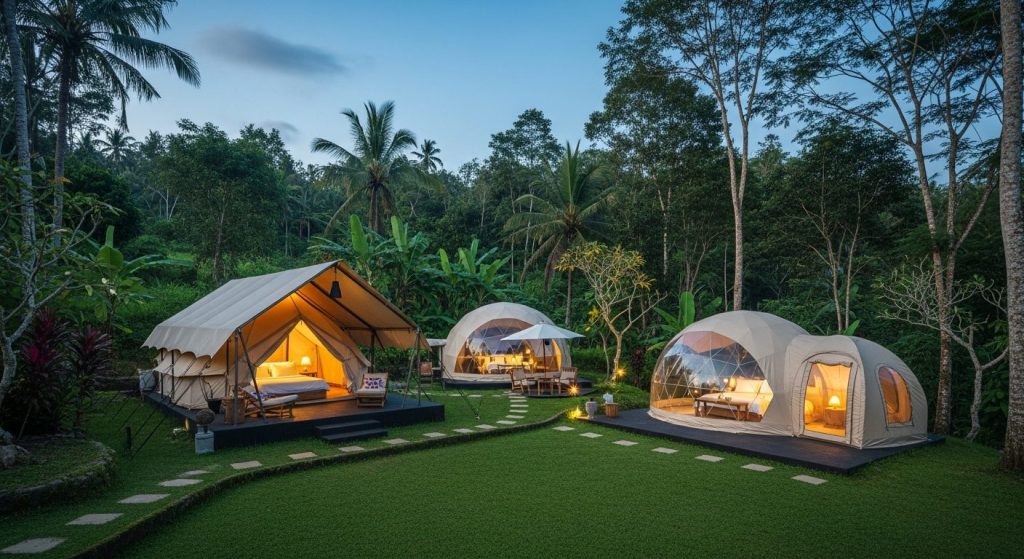
Glamping in Ubud means staying in a furnished safari tent, bell tent or eco-dome set among the rice terraces and river valleys around Bali’s cultural heartland, with a real bed, a proper bathroom and resort-style service rather than a sleeping bag on the ground. Across the wider island the same idea takes different forms: clifftop tents above Uluwatu’s surf, beach-facing setups near Sanur, and stargazing bubbles in the quieter interior. This page maps those options area by area so you can match a glamping style to the part of Bali you actually want to base in.
I am Dewa Putu Ardana, and I research Bali’s regions and the camps within them for Bali Camping Luxury. We are an independent guide and editorial concierge, not a camp operator. We do not own tents or land, and what follows is general information to help you choose a region, not booking, safety or licensed travel advice. When you decide to proceed with a glamping site or camp operator we have introduced you to, that partner may pay us a referral fee at no extra cost to you. Where I describe areas, I describe their general character; I do not invent operator names, awards or prices.
How to think about Bali’s glamping regions
Most travellers pick a glamping style first, then realise the style only exists in certain parts of the island. Jungle and rice-field setups cluster inland around Ubud, Tabanan and Gianyar. Beach and surf-town glamping sits along the south and southwest coast near Canggu, Seminyak and Sanur. Clifftop drama belongs to the Bukit Peninsula around Uluwatu. The offshore islands, especially Nusa Penida, offer the most remote feel but the longest journey.
Two practical things shape almost every decision: scenery and drive time. Bali’s traffic is real, and the gap between “20 minutes from the airport” and “two hours plus a fast boat” changes how a trip feels. The table below is a planning starting point, not a guarantee; drive times vary widely with season, time of day and where exactly a camp sits. Treat them as typical, last verified June 2026.
Bali glamping regions compared
| Area | General vibe | Typical scenery | Approx. drive from airport (DPS) | Often suits |
|---|---|---|---|---|
| Ubud | Cultural, calm, nature-immersed | Rice terraces, river gorges, jungle canopy | 1.25–1.75 hrs | Couples, honeymooners, wellness travellers |
| Tabanan | Rural, quiet, agricultural | Tegallalang-style terraces, Mount Batukaru foothills | 1.5–2.25 hrs | Couples and families wanting seclusion |
| Gianyar | Traditional, central, artisan villages | Rivers, ricefields, temple country | 1–1.5 hrs | Culture-focused couples and small groups |
| Canggu | Surf, café and remote-work energy | Black-sand beaches, ricefield fringes | 45 min–1.25 hrs | Digital nomads, social couples, surfers |
| Seminyak | Polished, beach-club, dining-led | Wide beaches, sunset coastline | 30–50 min | Style-led couples, short luxe breaks |
| Sanur | Gentle, low-key, family-friendly coast | Calm east-facing beach, sunrise views | 20–40 min | Families, slower-paced couples |
| Uluwatu / Bukit | Dramatic, surf-and-cliff, upscale | Limestone cliffs, ocean panoramas | 45 min–1.25 hrs | Honeymooners, view-seekers, surfers |
| Nusa Dua | Resort-zone, manicured, secure-feeling | Calm lagoon beaches, landscaped grounds | 20–40 min | Families, first-time visitors |
| Nusa Penida | Rugged, remote, adventure-led | Cliffs, viewpoints, undeveloped coast | 30 min to port + boat | Adventurous couples, photographers |
| Kuta | Busy, central, budget-to-mid | Long beach, dense town | 10–25 min | Convenience-first short stays |
Glamping in and around Ubud
Ubud is the centre of gravity for jungle and rice-field glamping in Bali. The land here folds into deep river valleys and stepped terraces, so a tent perched on a ridge can deliver the kind of green, layered view people picture when they imagine “glamping in Ubud.” The mood is unhurried and culture-led, with temples, art markets and wellness studios close at hand. It tends to suit couples, honeymooners and anyone who wants nature without leaving comfort behind.
Within the Ubud orbit, look at the surrounding districts too. Tegallalang to the north is known for sculpted rice terraces. Payangan and the Ayung river corridor offer gorge-side seclusion. Because Ubud sits inland, expect a longer transfer from the airport and winding final roads to more remote camps. The trade-off is quiet and scenery that the coastal areas cannot match.
What styles you tend to find inland
- Safari tents
- Larger canvas structures on raised platforms, usually with en-suite bathrooms and proper beds; common on terrace-edge plots.
- Bell tents
- Smaller, rounded canvas tents, often grouped; a lighter, more compact glamping format.
- Eco-domes and geodesic tents
- Transparent or semi-transparent domes positioned for jungle or sky views; favoured for design-led stays.
Canggu and the southwest coast
Canggu trades terraces for surf breaks, beach clubs and a strong café and co-working scene. Glamping here, and on its ricefield fringes toward Pererenan and Seseh, leans social and active. It is a natural base for remote workers and digital nomads, a group that market research consistently flags as one of glamping’s fastest-growing audiences, alongside couples who want nightlife and waves within reach. The closer you get to the coast, the more you trade quiet for convenience and energy.
Seminyak, Sanur, Kuta and Nusa Dua
These coastal zones are where Bali’s hotel infrastructure is densest, so dedicated glamping is rarer and tends to be smaller in scale. Seminyak is the polished, dining-and-beach-club end of the coast, well suited to short, design-conscious breaks. Sanur faces east, has calmer water and a gentler pace, which many families and slower-travelling couples prefer. Kuta is the most central and busy. Nusa Dua is a planned resort enclave with calm lagoon beaches and a secure, manicured feel that first-time visitors and families often like. If your priority is being steps from the sand and city services, these areas win on access even where tented options are limited.
Uluwatu, the Bukit Peninsula and the islands
The Bukit Peninsula around Uluwatu is Bali’s clifftop theatre: limestone headlands, big surf and wide ocean views. Glamping here, where it exists, sells the panorama, and the area draws honeymooners and view-seekers. Offshore, Nusa Penida is the most remote choice on this list, reached by road to a south Bali port and then a fast boat. Its scenery is rugged and dramatic, and it rewards travellers who treat the journey as part of the adventure rather than a chore. Because these areas are more exposed and seasonal, weather windows matter more, and conditions on the day are always the operator’s domain, not something any guide can promise.
Why glamping, and why curated
Glamping has matured from a novelty into an established, higher-spend segment. Independent research firms put the global glamping market at roughly USD 3.7–6.4 billion in the mid-2020s, with forecasts toward USD 7.9–11.1 billion by the early 2030s and compound annual growth rates around 9–11%. One report values the luxury-glamping segment specifically at about USD 3.2 billion in 2025, projected toward USD 8.1 billion by 2034 at roughly 12.4% a year, outpacing broader luxury hospitality. Demand skews toward couples, families with young children, remote workers and retreat groups, which closely matches the audiences these Bali regions serve.
Our role is to sit between you and that landscape as an independent guide. We compare areas and styles, then introduce your enquiry to vetted glamping sites and camp operators. Bookings, contracts, on-site service, safety and compliance all rest with those operators, never with us. If you proceed with a partner, they may pay us a referral fee at no extra cost to you, which keeps this guide free.
Ready to narrow it down? Tell us your dates, group and the region you are drawn to, and we will help you shortlist. Plan your Bali glamping escape and we will follow up, including over WhatsApp planning if that is easier for you.
Choosing by traveller type
- Couples and honeymooners
- Ubud for jungle privacy, Uluwatu for clifftop views; both lean romantic and view-led.
- Families
- Sanur and Nusa Dua for calm beaches and easy logistics; Tabanan for rural space.
- Remote workers and digital nomads
- Canggu for connectivity, cafés and a working community; confirm Wi-Fi and power directly with each operator.
- Retreat and small-group organisers
- Ubud and Tabanan for quiet, communal-friendly settings; group capacity and spaces are operator-specific.
Frequently asked questions
What is glamping in Ubud actually like?
It is a furnished tent or dome stay, usually with a real bed and en-suite bathroom, set among rice terraces or river-valley jungle near Bali’s cultural centre. Comfort levels and amenities vary by camp, so confirm specifics with the individual operator.
Which Bali area is best for first-time glampers?
There is no single answer, but couples often start with Ubud for scenery, while families lean toward Sanur or Nusa Dua for calm beaches and shorter transfers. The right fit depends on your priorities for vibe, scenery and drive time, which the comparison table above lays out.
How much does luxury glamping in Bali cost?
We do not publish fixed prices because rates are set by each operator and change with season and demand. As general market context, glamping internationally often runs higher per night than traditional camping. For Bali specifics, rely only on an operator’s own date-stamped pricing, which we can help you reach.
Do you own or run any of these camps?
No. Bali Camping Luxury is an independent curator and content publisher. We research and compare options and route enquiries to vetted glamping sites and camp operators. All bookings, contracts and on-site service are handled by those operators.
How do you make money if the guide is free?
If you proceed with a partner we introduce you to, they may pay us a referral fee at no extra cost to you. This is our only stated commercial model, and it keeps the guide free to use.